
A total of 22 local governments in New York state were designated in fiscal stress for their local fiscal years ending (FYE) in 2025, down from 23 a year ago. However, the number of municipalities in the most severe category, significant fiscal stress, increased from four to six, according to a report released today by State Comptroller Thomas P. DiNapoli. These designations are based on the Comptroller’s Fiscal Stress Monitoring System (FSMS) scores.
“Local governments are facing increased fiscal pressures due to a combination of the end of federal pandemic aid, higher inflation, rising operating costs and moderating sales tax revenue growth,” DiNapoli said. “Local officials should be pragmatic when planning future budgets, and I encourage them to use the FSMS information and tools we provide to help them make prudent financial decisions.”
DiNapoli launched FSMS in 2013 to evaluate fiscal stress for local governments, using objective scoring indicators based on year-end fund balance, operating deficits, cash-on-hand, short-term borrowing, and fixed costs. The system’s fiscal stress scoring provides an early warning to local officials about fiscal issues and gives the public insight into their local governments’ financial condition.
DiNapoli releases fiscal stress scores for municipalities, excluding New York City, twice a year. The scores announced today are for local governments operating on a calendar year basis for FYE 2025, covering all counties and towns, 44 cities and 13 villages. This round of scoring designated 15 local governments in fiscal stress, including eight cities, six towns and one village. In March, DiNapoli announced that seven villages with non-calendar fiscal years were designated in stress. School district scores were released in January.
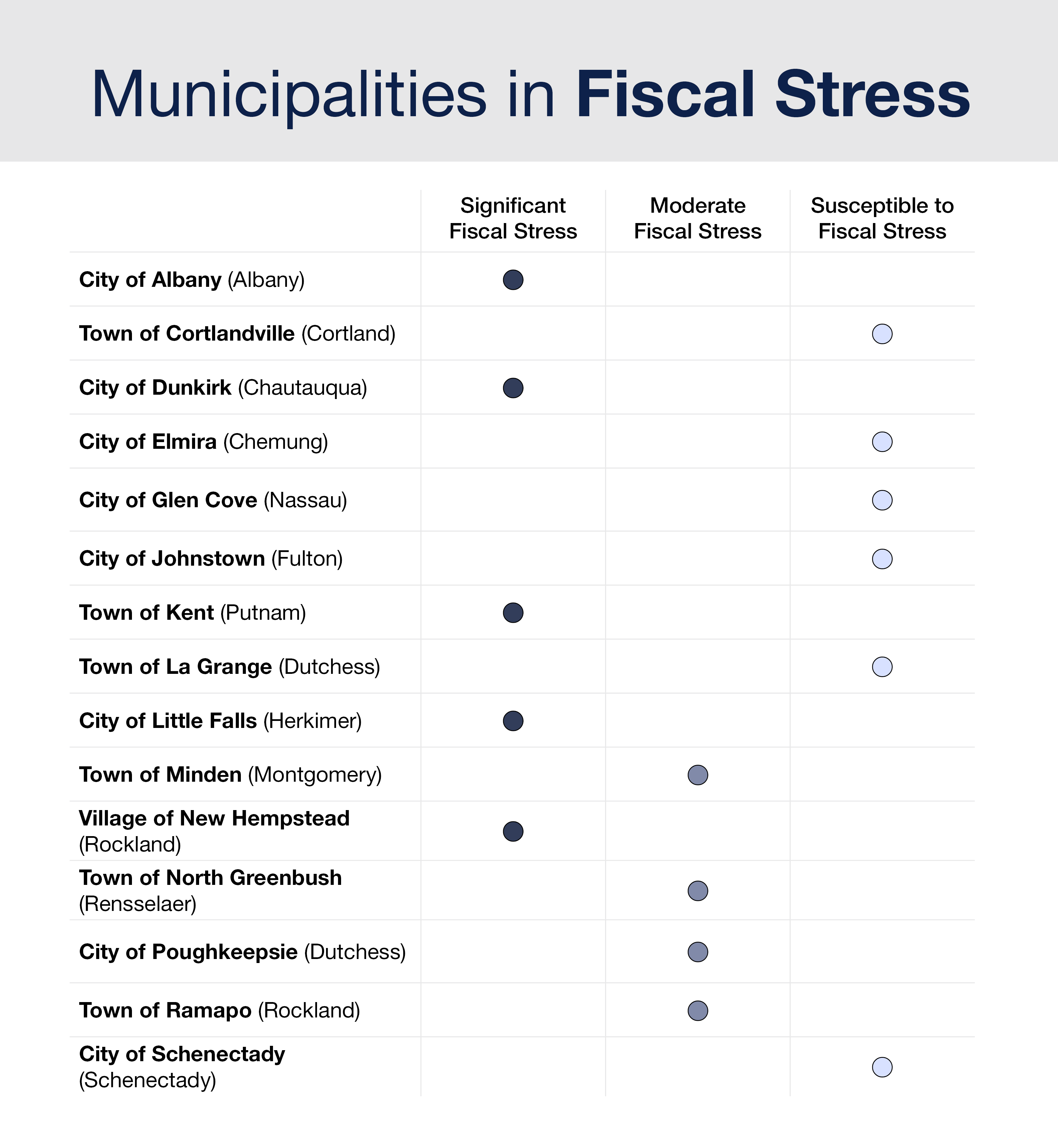
For this release, the cities of Albany (Albany County), Dunkirk (Chautauqua), and Little Falls (Herkimer), as well as the Town of Kent (Putnam) and the Village of New Hempstead (Rockland), were designated in the highest-ranking category of “significant stress.”
The City of Poughkeepsie (Dutchess) was designated in “moderate fiscal stress,” along with the towns of Minden (Montgomery), North Greenbush (Rensselaer), and Ramapo (Rockland).
The cities of Elmira (Chemung), Glen Cove (Nassau), Johnstown (Fulton), and Schenectady (Schenectady) were designated as “susceptible to fiscal stress,” along with the towns of Cortlandville (Cortland) and La Grange (Dutchess).
DiNapoli also released a report summarizing FYE 2025 fiscal stress scoring results for both calendar year and non-calendar year municipalities, including designations by class, FSMS indicator analysis, and issues of concern, among other things.
The report found that:
- The number of cities receiving a stress designation doubled to eight in FYE 2025 from 2024, while the number of towns and villages with a stress designation decreased from 19 to 14. For the fifth consecutive year, no counties received a fiscal stress designation.
- Of the 22 municipalities designated in fiscal stress in FYE 2025, 13 saw their FSMS score increase from the previous year. Nine of these entities had received no designation in 2024.
- Eight municipalities with a fiscal stress designation in FYE 2024 improved their score enough to receive no designation in 2025.
- A total of nine municipalities were designated in some level of fiscal stress in both FYE 2024 and 2025. Four of these nine entities (the cities of Albany, Poughkeepsie and Little Falls, and the Village of Coxsackie) have been designated in fiscal stress for four consecutive years.
The number of municipalities that did not file in time to receive a fiscal stress score more than doubled from FYE 2015 to 2023, when it reached an all-time high of 264. The number of FSMS non-filers has decreased since that peak, down to 225 in FYE 2025. The decline is particularly noticeable for cities, which improved the most in percentage terms, while towns improved the most in total numbers. This improvement in filing rates is due, in part, to recent initiatives by DiNapoli’s office to increase local officials’ awareness of and compliance with filing requirements.
Local governments that fail to file their financial reports are more likely to have poor fiscal practices than those that file in time and receive a score. Audits by DiNapoli’s office have found these entities frequently have problems with records management, billing, financial management, and internal controls.
Lists
Municipalities Designated in Stress for Fiscal Year Ending 2025
Municipalities That Did Not File in Time or Filed Inconclusively
Excel Spreadsheets
Detailed List of All Municipalities in State and Fiscal Stress Scores
FSMS Designation for Each Municipality FYE 2015 to 2025
Report
Fiscal Stress Monitoring System – Municipalities: Fiscal Year 2025 Results
Related Reports
Municipalities in Stress for Fiscal Years Ending 2025
School Districts in Stress for Fiscal Years Ending 2025
Boom or Bust? Federal Relief Aid and Local Government Finances in New York State.