

State Parks a Growing Attraction
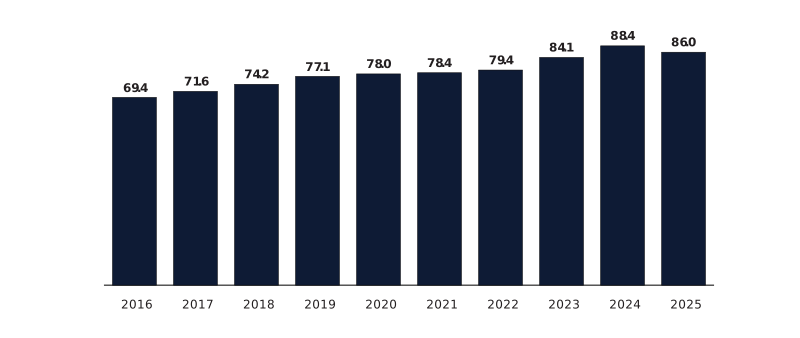
New York’s extensive network of state parks are an important public resource providing New Yorkers and visitors with green spaces, fresh air, and recreational and educational opportunities. The New York State Office of Parks, Recreation and Historic Preservation (OPRHP) is responsible for overseeing more than 250 parks, historic sites, and other recreation sites outside of the Catskills and Adirondack regions. These facilities are located in 56 of the state’s 62 counties and had 86 million visits in 2025. This marks a 10-year increase of 16.7 million visits (24 percent), or 45,701 more per day, since 2016.
Figure 1 – New York State Parks and Historic Sites Attendance (in millions)
- Figure 1 Data Table
Year Attendance 2016 69,351,725 2017 71,571,568 2018 74,185,653 2019 77,110,069 2020 78,019,700 2021 78,447,193 2022 79,448,251 2023 84,108,956 2024 88,378,737 2025 86,032,620
Source: Office of Parks, Recreation and Historic Preservation
Note: Data collected by OPRHP’s Agency Attendance reporting system, into which each state park facility reports estimated attendance information. At facilities operated by concessionaires or partner entities, attendance is reported to OPRHP by the partner annually.
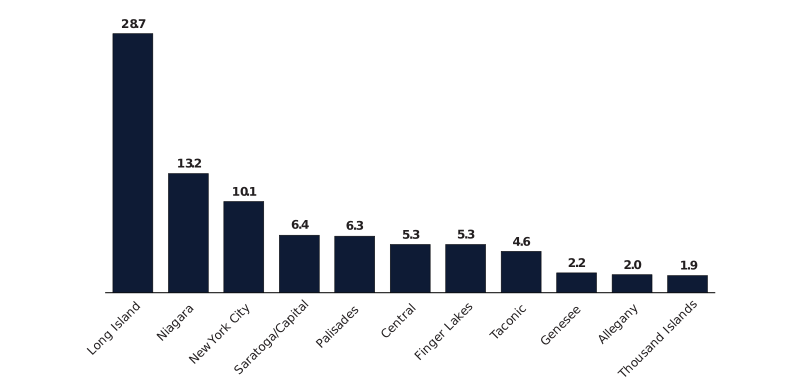
State Law establishes 12 park regions across the state. Attendance is greatest in the Long Island, Niagara and New York City regions.
Figure 2 – 2025 State Park Attendance by Region (in millions)
- Figure 2 Data Table
Park Region Park Attendance Long Island 28,706,873 Niagara 13,203,071 New York City 10,108,307 Saratoga/Capital 6,371,741 Palisades 6,263,815 Central 5,349,254 Finger Lakes 5,348,104 Taconic 4,585,285 Genesee 2,196,012 Allegany 1,999,478 Thousand Islands 1,900,680
Source: Office of Parks, Recreation and Historic Preservation
Note: Data collected by OPRHP’s Agency Attendance reporting system, into which each state park facility reports estimated attendance information. At facilities operated by concessionaires or partner entities, attendance is reported to OPRHP by the partner annually.
The two State parks with the largest attendance by far sit at almost opposite ends of the state. Niagara Falls had 8.9 million visitors in 2025 and Jones Beach had 7.9 million visitors. Niagara Falls is the oldest state park in the country, established in 1885. Over the past 10 years, attendance has surged at Gantry Plaza (an increase of 194 percent), Saratoga Springs (63 percent) and Jones Beach (34 percent).
Figure 3 – Ten State Parks with the Highest Attendance in 2025
| Facility | County | Attendance | Change Since 2016 |
|---|---|---|---|
| Niagara Reservation | Niagara | 8,905,883 | (623,442) |
| Jones Beach | Nassau | 7,913,408 | 2,003,070 |
| Gantry Plaza | Queens | 4,231,517 | 2,792,837 |
| Saratoga Springs | Saratoga | 3,723,579 | 1,441,152 |
| Robert Moses State Park | Suffolk | 3,635,161 | (622,199) |
| Sunken Meadow State Park | Suffolk | 3,551,316 | 673,835 |
| Riverbank State Park | New York | 3,210,633 | 93,177 |
| Bear Mountain State Park | Orange/Rockland | 2,091,384 | (82,588) |
| Green Lakes State Park | Onondaga | 1,961,135 | 976,380 |
| Watkins Glen State Park | Schuyler | 1,394,999 | 490,846 |
Source: Office of Parks, Recreation and Historic Preservation
Note: Data collected by OPRHP’s Agency Attendance reporting system, into which each state park facility reports estimated attendance information. At facilities operated by concessionaires or partner entities, attendance is reported to OPRHP by the partner annually.
In addition to parks managed by OPRHP, the Department of Environmental Conservation manages State lands in the Adirondacks and Catskills. The Adirondack Park’s six million acres are the largest protected region in the contiguous United States. According to the Adirondack Council, between 7 and 12.4 million people visit the Adirondack Park each year. The Catskills Park encompasses over 250,000 acres, 300 miles of trails, and more than 700 individual camping sites.
Parks provide benefits to the State and have demonstrated health benefits.1 They provide recreation, habitat for wildlife, and help to maintain a healthy ecosystem. According to New York State’s 2025-2030 State Comprehensive Outdoor Recreation Plan, more people are participating in outdoor recreation; however participants are recreating less frequently.
Between 2024 and 2025, there was a decrease of 2.3 million visits from the previous year (2.7percent). This decrease may have been partially a result of a wet spring followed by a hot and dry summer as well as park facility closures; however, the figures are also influenced by lower attendance from Canadian visitors, as tourism from Canada has declined. According to the Bureau of Economic Analysis, outdoor recreation accounts for 1.6 percent of New York’s GDP and over 264,000 jobs are attributable to outdoor recreation.
While the past 10 years demonstrate success, it is important to continue to encourage New Yorkers to take advantage of State gems—from urban oases to lakes and beaches to forests and natural wonders.
Endnote
1 Mychal Cohen, Kimberly Burrowes, and Peace Gwam, The Health Benefits of Parks and Their Economic Impacts | Urban Institute, February 28, 2022 (accessed March 5, 2026); Centers for Disease Control and Prevention, Parks, Recreation and Green Spaces | Active People, Healthy Nation (accessed March 5, 2026); and World Health Organization, Urban green spaces and health review evidence (accessed March 5, 2026).