
Residents of other countries travel to the United States for a variety of reasons: personal, business, education or health care. Recent policies at the federal level—including higher tariffs and immigration restrictions—have constrained international travel to the state and nationwide. For New York, these restrictions have led to a decline in visits from Canada which have been particularly detrimental to communities along the Canadian border.
Number of Overseas Travelers to the U.S. Declines
In 2025, there were 34.3 million visitations by overseas travelers to the U.S., just over 870,000 (2.5 percent) fewer than the same period in 2024.1 Figure 1 shows the monthly change in visitor arrivals over the course of the year.
Figure 1 – Year-over-Year Change in International Arrivals to the U.S.,
by Month, 2024 vs. 2025 (in thousands)
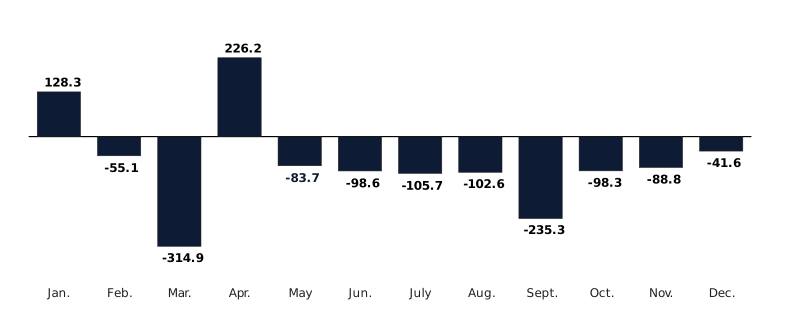
Note: Excludes arrivals from Canada and Mexico. December is preliminary.
Source: International Trade Administration
Of the types of travelers visiting the U.S., the largest share are tourists; 84.2 percent of visas were tourism visas in 2024. In 2025, the number of tourism visas declined by over 537,100 (1.6 percent) from 2024.2 Student visas, which comprised 4.5 percent of travelers in 2024, dropped by 13.5 percent, down by 197,355. Business visas decreased by almost 56,500 (1.2 percent). (See Figure 2.)
The change in student visas reflects a range of presidential Executive actions that have affected international student enrollment in New York and across the country, as described in this analysis from the Office of the State Comptroller. These actions include temporarily pausing new interviews of applicants, partially restricting entry from some nations, and revoking student visas.
Figure 2 – Year-over-Year Change in International Arrivals to the U.S.,
by Visa Type, 2025 (in thousands)
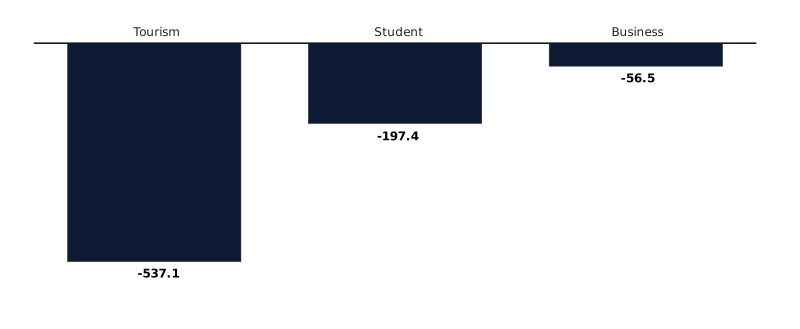
Note: Includes air travel from Mexico. December is preliminary
Source: International Trade Administration
In addition to the data from the I-94 arrivals program, which largely focuses on visitors who travel to the U.S. by either air or by sea, U.S. Customs and Border Protection provides statistics on the number of travelers presenting themselves at the various ports of entry to the country, including those arriving by land through passenger vehicles or pedestrian traffic. According to U.S. Customs and Border Protection, in 2025, 37.1 million and 181.7 million travelers came from Canada and Mexico, respectively.3 This was 15.5 million lower than in 2024, largely due to a 10.3 million (21.7 percent) decline in those from Canada; from Mexico, the decrease was 4.2 million (2.2 percent).
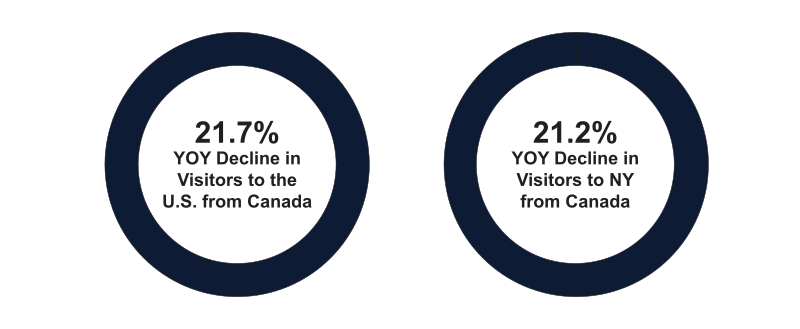
Source: U.S. Customs and Border Protection
New York Has Second Highest Decline in Overseas Travelers
At the end of 2024, with over 5.8 million arrivals from overseas, New York ranked second highest among the states in overseas travelers; Florida had the most, 7.2 million.4 In 2025, there were nearly 176,650 (3.0 percent) fewer visitations from overseas; only California had a higher decrease, over 275,000.5 The national decrease was 2.5 percent.
Figure 3 – Monthly Number of Travelers from Canada to New York, 2024 and 2025
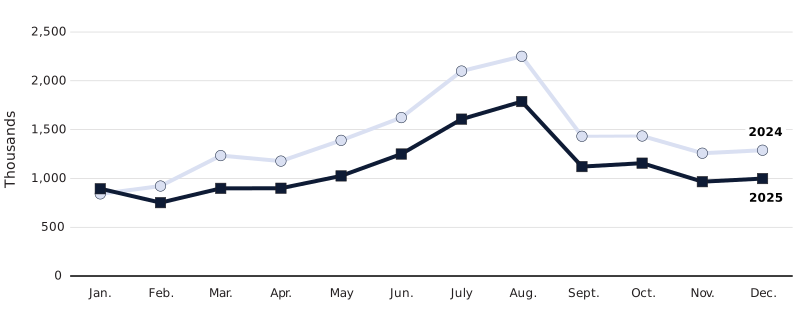
Note: Number of travelers does not necessarily equate to one visit to New York; one individual may make multiple trips.
Source: U.S. Customs and Border Protection.
Because the state shares a border with Canada, a significant number of visitors come to New York via passenger vehicle, or even on foot, and there has been a significant decrease in these trips to New York. In 2025, there were nearly 3.6 million fewer travelers crossing from Canada, a decline of 21.2 percent.6 As shown in Figure 3, the only month where the number was higher was in January.
With the decline in international visitors, attendance at many of the state’s national sites was down in 2025. According to the National Park Service, visitation to sites in New York dropped by 18.2 percent from 2024; most notably, there were nearly 183,800 (4.9 percent) fewer visitors to the Statue of Liberty through October 2025 (See Figure 4).7
Figure 4 – Attendance at Top 10 National Sites in New York, 2024 and 2025 (in thousands)
| National Park Service Site | 2025 | 2024 | Change |
|---|---|---|---|
| Gateway National Recreation Area | 7,696.9 | 8,929.0 | (1,232.1) |
| Castle Clinton National Monument | 3,656.4 | 3,822.8 | (166.4) |
| Statue of Liberty National Monument | 3,538.2 | 3,722.0 | (183.8) |
| Upper Delaware Scenic & Recreational River | 380.2 | 377.1 | 3.2 |
| Fire Island National Seashore | 305.5 | 303.7 | 1.8 |
| Stonewall National Monument | 298.1 | 2,302.6 | (2,004.6) |
| Vanderbilt Mansion National Historic Site | 295.0 | 406.1 | (111.0) |
| Sagamore Hill National Historical Site | 122.1 | 130.3 | (8.1) |
| Saratoga National Historical Park | 119.3 | 116.5 | 2.7 |
| Home of Franklin D. Roosevelt National Historical Site | 101.9 | 123.8 | (21.9) |
| Total All Sites | 16,959.6 | 20,731.0 | (3,771.4) |
Note: Recreational visits. The Gateway National Recreation Area spans New York and New Jersey; the Upper Delaware Scenic & Recreational River spans New York and Pennsylvania.
Source: National Park Service
Attendance at state parks also declined in 2025, by over 2.3 million (2.6 percent). With the decrease in Canadian border crossings, the Niagara Reservation, which includes Niagara Falls, had over 610,000 (6.4 percent) fewer visitors in 2025 (See Figure 5); for all state parks in Western New York, there was a net decline of 2.9 percent.8 In the North Country, state park attendance decreased by a net of 19,060 (0.9 percent).9
Figure 5 – Attendance at Top 10 New York State Parks, 2024 and 2025 (in thousands)
| State Park | County | 2025 | 2024 | Change |
|---|---|---|---|---|
| Niagara Reservation | Niagara | 8,905.9 | 9,516.0 | (610.1) |
| Jones Beach | Nassau | 7,913.4 | 9,534.7 | (1,621.3) |
| Gantry Plaza | Queens | 4,231.5 | 3,005.2 | 1,226.3 |
| Saratoga Springs | Saratoga | 3,723.6 | 3,934.0 | (210.4) |
| Robert Moses | Suffolk | 3,635.2 | 3,937.8 | (302.7) |
| Sunken Meadow | Suffolk | 3,551.3 | 3,529.0 | 22.3 |
| Riverbank | New York | 3,210.6 | 3,817.2 | (606.6) |
| Bear Mountain | Orange/Rockland | 2,091.4 | 2,766.7 | (675.3) |
| Green Lakes | Onondaga | 1,961.1 | 1,477.9 | 483.2 |
| All State Parks | 86,032.6 | 88,378.7 | (2,346.1) |
Note: Attendance at Saratoga Springs State Park includes that at Victoria Pool and the golf course. There are two Robert Moses state parks in New York; the second located in St. Lawrence County.
Source: NYS Office of Parks, Recreation, and Historic Preservation, Annual Attendance Figures
Fewer Travelers, Lower U.S. Spending
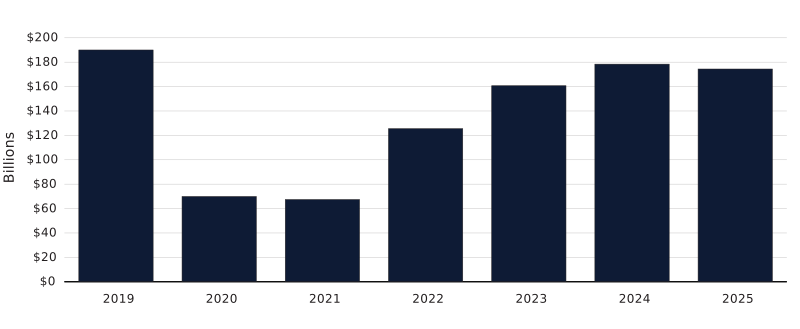
Spending by travelers from other countries in the U.S. includes the purchase of a variety of goods and services, primarily lodging, meals, transportation in the country of travel (excluding travel between countries, specifically air passenger services), amusement, entertainment, and gifts.10 In 2025, real spending by international visitors totaled $174.4 billion, 0.7 percent of Gross Domestic Product (GDP).11
Figure 6 – Spending by International Travelers in the U.S., 2019 – 2025
Source: U.S. Bureau of Economic Analysis, International Trade in Goods and Services
Over half of the expenditures by travelers to the U.S. were for personal/tourism purposes in 2024. When combined with business travel, the share increases to 64.0 percent. Through the third quarter of 2025 (the latest data available), both had decreased.12
Figure 7 – Real Spending on Travel to the U.S. through the Third Quarter,
by Type of Travel, 2024 and 2025 (dollars in billions)
| Travel Type | YTD Third Quarter 2024 | YTD Third Quarter 2025 | ||||
|---|---|---|---|---|---|---|
| Total Spending | Change from Prior Year | Total Spending | Change from Prior Year | |||
| Amount | Percent | Amount | Percent | |||
| Personal Travel | $92.3 | $12.3 | 15.3% | $89.0 | ($3.3) | -3.6% |
| Medical/Education | $48.6 | $4.2 | 9.5% | $50.0 | $1.4 | 2.9% |
| Business Travel | $21.2 | $2.7 | 14.6% | $20.9 | ($0.3) | -1.4% |
| Seasonal/Short-Term Worker | $13.5 | $0.3 | 2.5% | $13.8 | $0.3 | 2.2% |
Note: Latest date available. Seasonally adjusted, annual rates. Personal/business travel spending includes purchases of goods and services such as food, lodging, gifts, entertainment, local transportation in the U.S. and other incidental items. Spending by workers includes all purchases made by border, seasonal, and other short-term workers. Expenditures for education and medical purposes include tuition, room and board paid for or provided by educational institutions, hospital charges, treatments, physicians’ fees, etc. made by students and medical patients.
Source: U.S. Bureau of Economic Analysis, International Trade in Goods and Services
New York Economic Impacts
Personal consumption expenditures by international travelers in New York totaled nearly $17 billion in 2024, according to the Bureau of Economic Analysis.13 Through the third quarter of 2025, real GDP in New York for industries associated with tourism exhibited no growth from the final quarter of 2024 (on a seasonally adjusted annual basis).14
In 2025, hotel occupancy decreased by 1.2 percent from 2024. For New York City, the year-over-year change in occupancy was relatively flat, a decrease of 0.2 percent.15 In addition, 2.9 million fewer people are projected to visit the city in 2025, with spending expected to decrease by $6 billion.16
Results have been similar in other areas of the state. In Buffalo, occupancy rates have been relatively the same in 2025 as in 2024. However, this is due to the lower availability of hotel rooms; occupancy has decreased by nearly 1 percent.17 In the Capital Region, hotel occupancy rates were down in Albany, Warren, and Schenectady counties and flat in Saratoga County in the first half of the year.18
In 2024, there were over 932,400 private sector jobs in New York in industries associated with international travel which paid over $45.4 billion in wages; nearly three-quarters of the employment (74.2 percent) was in accommodation and food services.19
Through September 2025, average employment in these industries increased by 1,782 jobs, 0.2 percent, over the same period in 2024; in comparison, private sector job growth in all other industries in the state was 1.0 percent.20 However, in accommodation and food services, there were 798 fewer jobs, a decline of 0.1 percent.
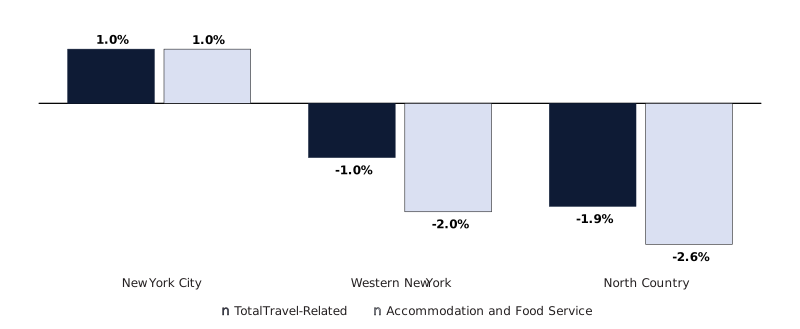
Employment growth in travel-related industries was stronger in New York City during this time, with average employment increasing by 1 percent. However, in those regions of the state near the Canadian border, travel-related employment declined through September (see Figure 8). While the North Country had the highest rate of decline, 1.9 percent, Western New York lost the largest number of jobs, 656.21
For the accommodation and food services subsector, employment growth was only slightly slower than for the overall industry in New York City. In the other two regions, the decline in jobs was more pronounced. This was particularly true in Western New York, where the drop in accommodation and food services employment was a full percentage point higher.22
Figure 8 – Year-over-Year Change in Employment, Total Travel-Related Industries and Accommodation
and Food Services, Select Regions, January to September, 2024 and 2025
Note: Average of monthly employment. Included industries may not be applicable to all regions and/or, due to disclosure provisions, data may not be available for all regions: Gift, Novelty, and Souvenir Retailers (NAICS 45942), Scheduled Air Passenger Transportation (481111), Nonscheduled Air Passenger Chartering (481211), Deep Sea Passenger Transportation (483112), Charter Bus Industry (4855), Scenic and Sightseeing Transportation (487), Passenger Car Rental (532111), Translation and Interpretation Services (54193), Travel Arrangement and Reservation Services (5615), Performing Arts and Spectator Sports (711), Museums Parks and Historical Sites (712), Amusement, Gambling, and Recreation (713), Accommodation (721), Mobile Food Services (NAICS 72233), Drinking Places (7224), Restaurants (7225).
Source: New York State Department of Labor, Quarterly Census of Employment and Wages
Conclusion
Policies enacted at the federal level, including increased tariffs and immigration restrictions, have adversely impacted the number of international visitors and the billions of dollars they spend. This spending supports millions of jobs across the country as well as hundreds of thousands of jobs in the state. According to the latest data available, the lower number of travelers and associated spending has had an adverse impact on industry employment, particularly in accommodations and food services. Increases in inflation may also cause these travelers to continue to eschew travel to the U.S., taking their money with them.
Endnotes
1 U.S. Department of Commerce, International Trade Administration, International Visitors Arrivals Program, accessed on November 26, 2025.
2 Includes visas for travelers from Mexico arriving via air travel as well as overseas travelers.
3 These statistics represent the inbound travelers that request entry into the U.S. via passenger vehicle or on foot (pedestrians); not all travelers are deemed admissible to the U.S. U.S. Customs and Border Protection, Traveler and Conveyance Statistics, FY23 – FY26 (FYTD) – December, accessed on March 3, 2026.
4 Based on the reported first intended address of the visitor. When including those who have traveled from Mexico by air, the number of arrivals to New York and Florida increases to 6 million and 7.7 million, respectively. U.S. Department of Commerce, International Trade Administration, Historical I-94 Visitor Data, December 2024, Table G accessed on December 1, 2025
5 There was an increase of nearly 3,000 arrivals by air from Mexico in New York in 2025 compared to 2024. While Florida saw an increase in the number of international travelers over this period (95,807), this increase could potentially be due the number of hurricanes that hit the U.S. in 2024, particularly hurricanes Helene and Milton at the end of September and beginning of October. U.S. Department of Commerce, International Trade Administration, International Visitors Arrivals Program, I-94 Monthly Summary Analysis, December 2025 COR Summary & Analysis accessed on March 3, 2026.
6 U.S. Customs and Border Protection, Traveler and Conveyance Statistics, FY23 – FY26 (FYTD) – December, accessed on March 3, 2026.
7 National Park Service, U.S. Department of the Interior, National Park Service Visitor Use Statistics, Recreation Visits by Month, accessed on March 3, 2026. The federal government shutdown likely impacted attendance in October and November.
8 New York State Office for Parks, Recreation and Historic Preservation, State Park Annual Attendance Figures by Facility, accessed on March 3, 2026
9 Ibid. Data for the North Country include state parks in the counties of Clinton, Essex, Jefferson, Lewis, St. Lawrence, and Washington.
10 According to the U.S. Bureau of Economic Analysis, statistics on spending by travelers to the U.S. are reflected as exports of travel services. U.S. Bureau of Economic Analysis, U.S. International Trade in Goods and Services, See explanatory notes.
11 U.S. Bureau of Economic Analysis, National Data, National Income and Product Accounts, Table 4.2.6B, Real Exports and Imports of Goods and Services by Type of Product, Chained Dollars, on an annual basis, accessed on March 3, 2026. All travel purposes include 1) business travel, including expenditures by border, seasonal, and other short-term workers and 2) personal travel, including health-related and education-related travel.
12 Visitors to the U.S. for medical, education, or employment purposes are typically in the U.S. for longer periods of time and incur higher costs. While travel is typically for durations of less than one year, that for education- or health-related purposes can be for longer periods. U.S. Bureau of Economic Analysis, National Data, National Income and Product Accounts, Table 4.2.6B, Real Exports and Imports of Goods and Services by Type of Product, Chained Dollars, on a quarterly basis, accessed on March 3, 2026
13 U.S. Bureau of Economic Analysis, Personal Consumption Expenditures (PCE) by state by type of product (SAPCE3), line 110, accessed on December 1, 2025.
14 Personal consumption expenditures by state are only published on an annual basis. Real GDP at the state level is defined as the net output of the industries in the state and for tourism related industries totaled $161.5 billion GDP in the third quarter of 2025, $21.6 million higher than the fourth quarter of 2024. Tourism associated industries include retail trade, arts, entertainment and recreation, and accommodation and food services. Amounts presented are for all industries within those larger sectors as quarterly GDP amounts are not presented beyond the two-digit NAICS codes. U.S. Bureau of Economic Analysis, SQGDP9 Real GDP by state, accessed Wednesday, March 4, 2026.
15 CoStar, “U.S. Hotels Report First Full-year Occupancy, RevPAR Declines since 2020”; January 20, 2026.
16 Larry Brain, “New York City’s Tourist Numbers Are Falling Sharply”, October 27,2027, Tourism Review News.
17 Jonathan D. Epstein, “Does Buffalo Need More Hotel Rooms? Event Planners Say It’s a Big Problem”, November 12, 2025, The Buffalo News/Hotel Online.
18 Mike DeMasi, “Local Tourism Officials Remain Optimistic Despite Softening Hotel Market”, July 24, 2025, Albany Business Review
19 Average of monthly employment for the first three quarters of 2024 and 2025. New York State Department of Labor, Quarterly Census of Employment and Wages, Gift, Novelty, and Souvenir Retailers (NAICS 45942), Scheduled Air Passenger Transportation (NAICS 481111), Nonscheduled Air Passenger Chartering (NAICS 481211), Deep Sea Passenger Transportation (NAICS 483112), Charter Bus Industry (NAICS 4855), Scenic and Sightseeing Transportation (NAICS 487), Passenger Car Rental (NAICS 532111), Translation and Interpretation Services (NAICS 54193), Travel Arrangement and Reservation Services (NAICS 5615), Performing Arts and Spectator Sports (NAICS 711), Museums Parks and Historical Sites (NAICS 712), Amusement, Gambling, and Recreation (NAICS 713), Accommodation (NAICS 721), Mobile Food Services (NAICS 72233), Drinking Places (NAICS 7224), Restaurants (NAICS 7225), accessed on December 10, 2025
20 Ibid.
21 Ibid.
22 Ibid.