2021 Financial Condition Report
For Fiscal Year Ended March 31, 2021
Data Sources
- Center for the Study of Education Policy, Illinois State University
- City of New York Department of Correction
- City University of New York
- Federal Reserve Bank of New York
- Fitch Ratings
- IHS Markit
- Internal Revenue Service
- Moody’s Investors Service
- National Association of State Budget Officers
- NYC Office of Management and Budget
- NYS Department of Agriculture and Markets
- NYS Department of Corrections and Community Supervision
- NYS Department of Environmental Conservatio
2021 Financial Condition Report
For Fiscal Year Ended March 31, 2021
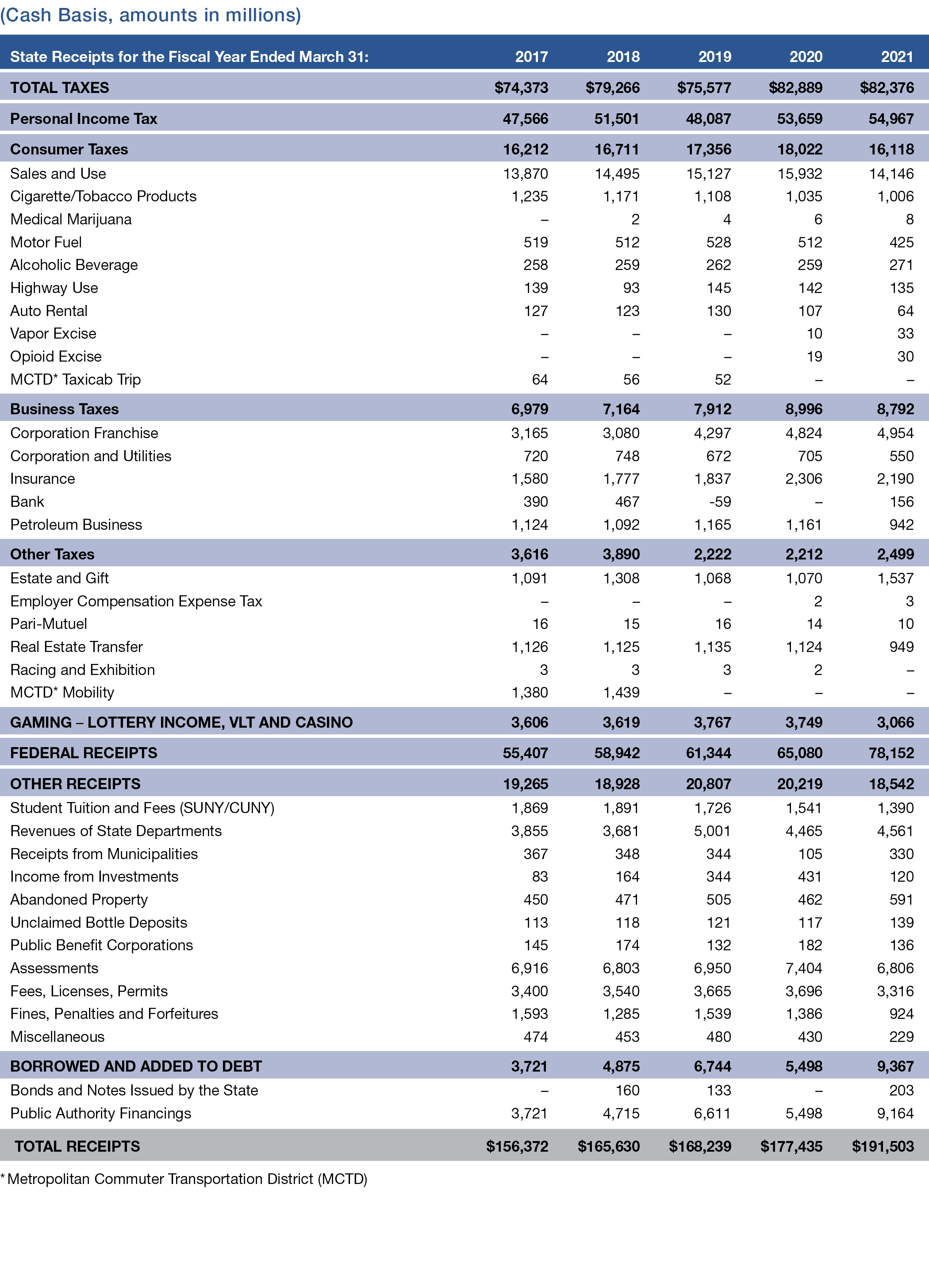
Appendix 3: State Receipts by Major Source
2021 Financial Condition Report
For Fiscal Year Ended March 31, 2021
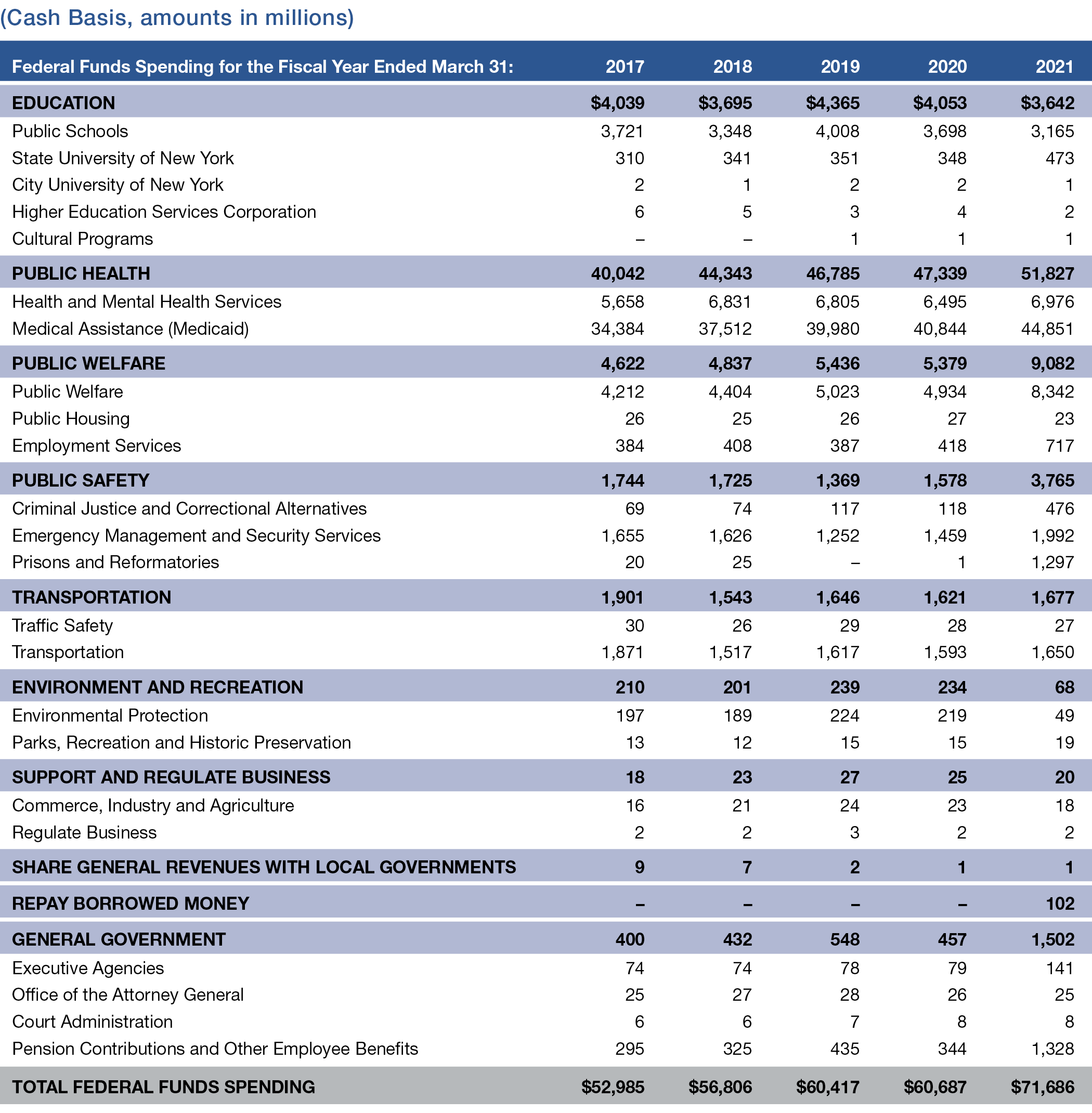
Appendix 2: Federal Funds Spending by Major Function
2021 Financial Condition Report
For Fiscal Year Ended March 31, 2021
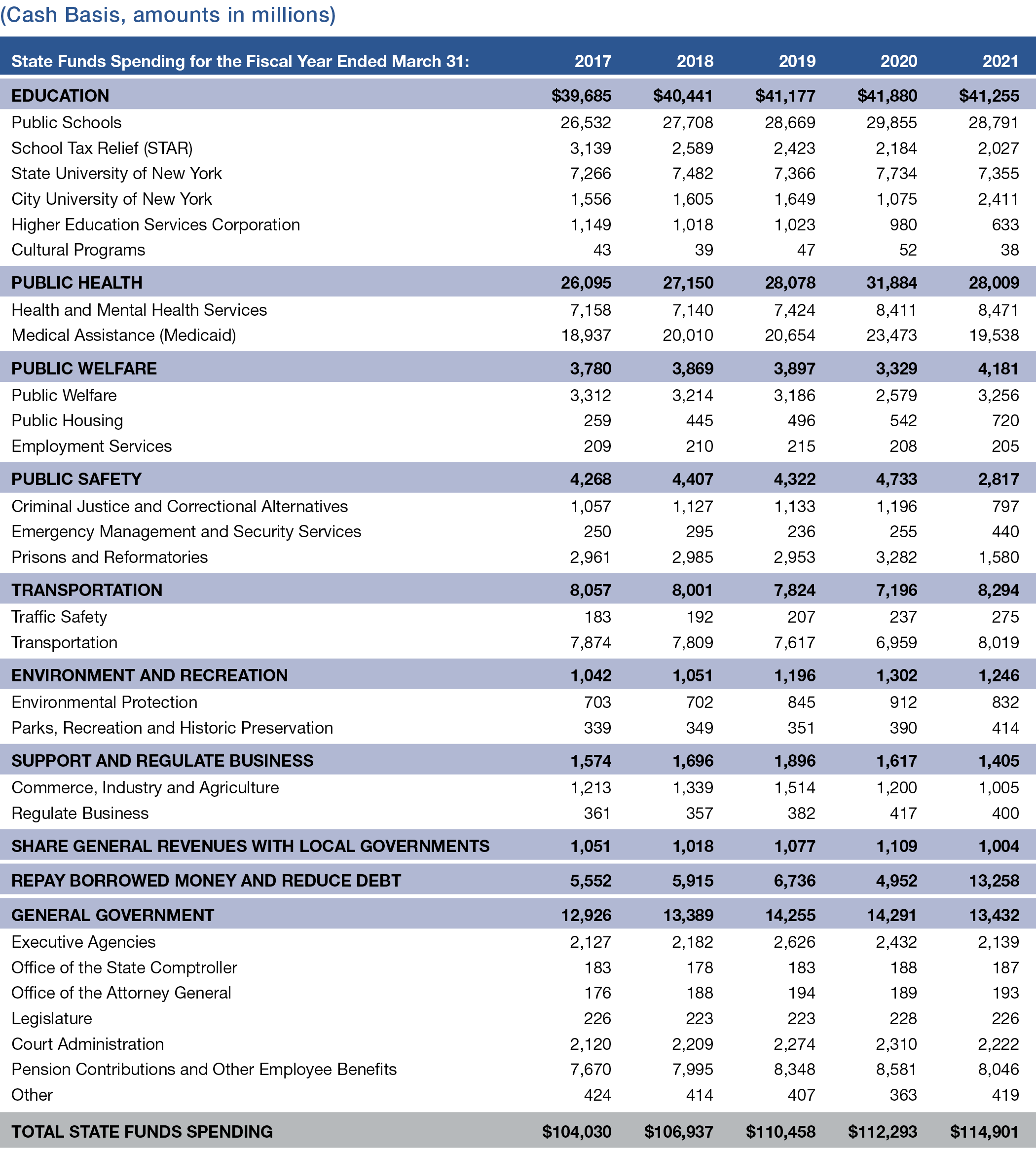
Appendix 1: State Funds Spending by Major Function
2021 Financial Condition Report
For Fiscal Year Ended March 31, 2021
Implications for the Future
The Economic Outlook: Employment Struggles and Uncertainty Remains
While the recession brought on by the COVID-19 pandemic was short-lived, employment has yet to recover fully. During March and April 2020, nearly 2 million jobs were lost in New York State and, as of August 2021, only 55 percent of those jobs were regained. No region of the State has returned to pre-pandemic employment levels with New York City trailing its February 2020 levels by over 500,000 jobs.
2021 Financial Condition Report
For Fiscal Year Ended March 31, 2021
Taxes
State Tax Collections Decreased Slightly in SFY 2020-21 from $82.9 Billion to $82.4 Billion
- In SFY 2020-21, reported New York State tax collections decreased by 0.6 percent, primarily reflecting the adverse economic impact of the COVID-19 pandemic.
- Collections for consumption and use taxes, New York State’s second largest tax revenue source, were the lowest since SFY 2016-17 and declined 10.6 percent from the previous year.
- A 24.4 percent growth in personal income tax collections, buoyed by an estimated 6.8 percent increase in securities industry bonu
2021 Financial Condition Report
For Fiscal Year Ended March 31, 2021
Economic and Demographic Trends
Employment Statewide Declined in 2020 Due to the COVID-19 Pandemic
- In calendar year 2020, the State lost over 955,000 jobs, a decrease of 10.0 percent compared to the decline nationally of 6.1 percent.
- New York ranked second among the states for job losses in 2020; California ranked highest with a decline of over 1.25 million.
- The State’s unemployment rate climbed to a high of 16.2 percent in April 2020 and ended the year at 10.0 percent.
- All industries in the State experienced job losses.
2021 Financial Condition Report
For Fiscal Year Ended March 31, 2021
Public Authorities
Public authorities are legally separate public entities that provide services to the public as well as to the State and local governments. New Yorkers pay for public authorities in a variety of ways including rates, tolls, fees, and in some cases, taxes. Public authorities are generally self-supporting through their revenue-generating activities; however, in some cases, governmental financial assistance and support is provided for operating and other expenses.
2021 Financial Condition Report
For Fiscal Year Ended March 31, 2021
Debt
The debt burden of a governmental entity creates fixed costs that directly affect its ability to provide current services, as well as its long-term fiscal health. High borrowing levels may:
2021 Financial Condition Report
For Fiscal Year Ended March 31, 2021
Local Government
Real Property Taxes and Sales Taxes Are Major Local Revenue Sources
- Real property taxes remain the single largest source of local government revenue in the State, accounting for $36.6 billion, or 43 percent, of the $85 billion in total revenue from local fiscal years ending in 2019 (not including New York City).
- School districts and towns received $22.9 billion and $4.3 billion, respectively, in revenues from real property taxes (representing 53 percent of total revenues for each), while villages received $1.4 billion (47 percent).