2020 Financial Condition Report
For Fiscal Year Ended March 31, 2020
Public Safety
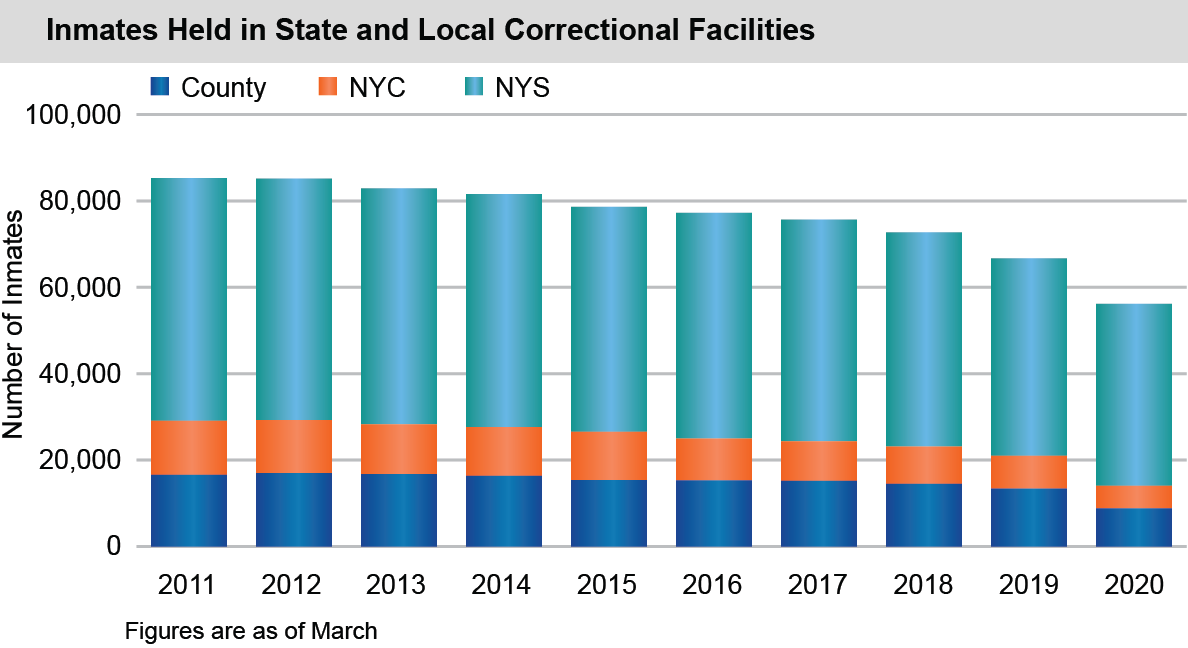
Inmate Populations and Crime Rates Continue Dropping
- As of March 2020, approximately 56,137 inmates were held in 133 State and local correctional facilities, which include:
- 52 State correctional facilities;
- 64 county jail and correctional facilities; and
- 17 New York City correctional facilities.
2020 Financial Condition Report
For Fiscal Year Ended March 31, 2020
Public Welfare
Caseloads Decreased in SFY 2019-20 Before the Impact of the COVID-19 Pandemic
- Numbers of recipients of Public Assistance (PA), the Supplemental Nutrition Assistance Program (SNAP) and Supplemental Security Insurance (SSI) all declined in SFY 2019-20, continuing trends of recent years in each case.
- The advent of the COVID-19 pandemic in New York State near the end of the fiscal year was followed by significant increases in enrollment and spending for PA and SNAP in the first few months of SFY 2020-21.
2020 Financial Condition Report
For Fiscal Year Ended March 31, 2020
Public Health
Pandemic Brings Jump in Medicaid Enrollment
- After a modest decrease of 0.3 percent on an average monthly basis in SFY 2019-20, Department of Health (DOH) Medicaid enrollment rose significantly in the wake of the COVID-19 pandemic near the end of SFY 2019-20 and into the new fiscal year.
2020 Financial Condition Report
For Fiscal Year Ended March 31, 2020
Capital
A robust, efficiently managed capital investment program can support healthy economic growth, while the deterioration of capital assets can weaken the State’s economy and its ability to attract and retain business. Capital assets include not only highways and bridges, but also facilities for education, government, health, housing, environmental conservation and recreation.
2020 Financial Condition Report
For Fiscal Year Ended March 31, 2020
Total Spending
Spending generally reflects the State’s program priorities. Comparing spending to revenue provides an indication of the State’s ability to support continuing programs. State spending, which includes spending from federal funds, is recorded on a cash basis.
See Appendices 1 and 2 for a breakdown of State spending by major service function and funding source for the past five years.
2020 Financial Condition Report
For Fiscal Year Ended March 31, 2020
Total Receipts
Revenues are affected by economic changes as well as changes in federal and State policies. Tax base is a measure of the State’s ability to generate revenue. A decreasing tax base may force spending reductions, increased taxes, or both. Receipts are revenues that have been recorded on a cash basis.
See Appendix 3 for a breakdown of State receipts by major source for the past five State fiscal years.
2020 Financial Condition Report
For Fiscal Year Ended March 31, 2020
Fund Financial Data
Fund financial statements provide a short-term view of finances. As such, these statements only focus on the inflows and outflows of current financial resources—cash or liquid assets that are available to pay current obligations (or will be soon).
Funds represent sources of funding and spending for particular purposes.
2020 Financial Condition Report
For Fiscal Year Ended March 31, 2020
Government-Wide Financial Data
Government-wide financial statements provide a long-term view of finances. They record revenues and expenses when the earnings process is complete (full accrual basis), as opposed to when they are actually received or paid (cash basis).
Each statement breaks down the activities of State government into two types:
2020 Financial Condition Report
For Fiscal Year Ended March 31, 2020
Message from the Comptroller
2020 Financial Condition Report
For Fiscal Year Ended March 31, 2020
About this Report