
The U.S. has a long history of imposing tariffs on goods imported into the country; for the most part, tariffs make the cost of foreign goods more expensive to U.S. consumers. Over the course of 2025, tariff levels were in flux; 43 executive orders were issued modifying tariffs on specific types of products or on specific countries.1 In addition, trade agreements were either made or amended which also modified tariff levels. These varying tariff policies injected uncertainty into the economy.2
As a result of the new policies, U.S. exports declined to over one-third of the nation’s trading partners and to almost one-half of New York’s trading partners in 2025. Among the highest declines were in exports to Canada, the State’s most significant trading partner. Exports of more than two-thirds of product categories from New York declined, as well. In addition to impacting the operations of New York’s farms and businesses, the tariff policies are contributing to elevated prices for household goods, and research indicates the burdens of tariffs are borne by both U.S. businesses and consumers. As tariff policies continue to shift under judicial review and additional Executive actions, uncertainty for businesses and inflationary pressures for consumers are likely to remain elevated throughout 2026.
Impact on U.S. Trading Partners
With the initial announcement of higher tariffs at the beginning of 2025, imports into the U.S. increased significantly as companies grew their inventories ahead of the tariff implementation date. From January to March 2025, imports of goods totaled $948.1 billion, an increase of $193.1 billion (25.6 percent) from the same period in 2024.3 While they slowed over the remainder of the year, total imports were $149.3 billion, 4.6 percent higher than in 2024.4
In comparison, exports of goods from the U.S. increased in 2025 by $123.5 billion, 6.0 percent higher than in 2024. As a result, the trade deficit, excluding services, in 2025 was $1.2 trillion, $25.8 billion higher than that in 2024.5
The amount of imports and exports reported are based on the price paid for those goods; when adjusting for the change in prices, real import growth in 2025 was over double that of export growth, an increase of $119.6 billion compared to $54.3 billion in real exports. The trade deficit in goods, on a real basis, was $65.3 billion higher in 2025.6
Mexico, Canada, and China are the nation’s largest trading partners; in 2024, they accounted for over 40 percent of both exports and imports. Imports from China and Canada declined significantly in 2025 by 29.7 percent and 7.0 percent, respectively. Exports to these countries declined, as well; those to China decreased by 25.8 percent and to Canada 3.8 percent.7
Impact on the New York Trade
New York’s farms and businesses trade with over 200 countries across the world, totaling $94 billion in exports and $159.8 billion in imports in 2024.8 Among the states, New York was the third largest exporter, behind Texas and California, and the fifth largest importer.
Canada is the state’s largest trading partner, comprising 21.6 percent of exports and 12.8 percent of imports in 2024, respectively. Switzerland, Hong Kong, the United Kingdom and Israel are top markets for New York’s businesses, while New York imports are largely from Switzerland, China, India and Italy.
Figure 1 – New York’s Top Trading Partners, 2024 (dollar amounts in millions)
| Exports | Imports | ||||
|---|---|---|---|---|---|
| Amount | Share of Total | Amount | Share of Total | ||
| Canada | $20,334.4 | 21.6% | Canada | $20,532.9 | 12.8% |
| Switzerland | $10,087.7 | 10.7% | Switzerland | $18,667.8 | 11.7% |
| Hong Kong | $8,056.5 | 8.6% | China | $18,609.9 | 11.6% |
| United Kingdom | $5,441.9 | 5.8% | India | $14,134.6 | 8.8% |
| Israel | $5,167.4 | 5.5% | Italy | $8,601.5 | 5.4% |
| Mexico | $3,745.8 | 4.0% | France | $7,855.9 | 4.9% |
| Germany | $3,707.6 | 3.9% | Israel | $5,100.7 | 3.2% |
| India | $3,663.2 | 3.9% | Vietnam | $4,691.4 | 2.9% |
| Singapore | $3,280.1 | 3.5% | Germany | $4,530.0 | 2.8% |
| China | $2,957.8 | 3.1% | South Africa | $4,204.0 | 2.6% |
| France | $2,853.5 | 3.0% | United Kingdom | $4,167.3 | 2.6% |
| United Arab Emirates | $2,547.2 | 2.7% | Hong Kong | $3,856.6 | 2.4% |
| Belgium | $2,334.8 | 2.5% | Japan | $3,543.5 | 2.2% |
| Taiwan | $1,767.5 | 1.9% | Mexico | $3,526.6 | 2.2% |
| Japan | $1,694.6 | 1.8% | South Korea | $2,892.6 | 1.8% |
| All Other | $16,396.4 | 17.4% | All Other | $34,896.6 | 21.8% |
Source: U.S. Census Bureau, USA Trade Online
In 2025, the State’s total exports and imports increased by $59 billion and $54 billion, respectively. However, results among New York’s trading partners were mixed. For example, exports to the United Kingdom, Switzerland and Hong Kong increased. Those to Switzerland and the United Kingdom were over triple the amount in 2024, primarily reflecting significant growth in the trade of goods manufactured from nonferrous metal, excluding aluminum; these two countries comprise over half of New York’s exports and imports for these goods.9 Export growth was likely influenced by the significant increase in prices of the underlying metals. Because trade is presented in the dollar value and not as quantities of goods, the change in prices also affects the year-over-year growth.10 Excluding these products, New York exports declined, on a net basis, by $3.4 billion.
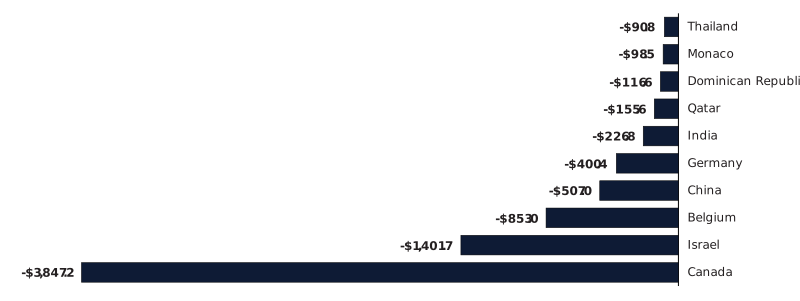
Exports to almost half of the nations (46.1 percent) declined; those to Canada decreased by $3.8 billion and to Israel by $1.4 billion. While Belgium is not one of the state’s largest trading partners, it had the third largest decline in exports in 2025, $853 million (36.5 percent).
Figure 2 – Decline in New York Exports, Selected Trading Partners, 2025 (millions of dollars)
Source: U.S. Census Bureau, USA Trade Online
Exports from New York are Primarily Manufactured Goods
In relation to the various commodities New York exports, over three-quarters (77.5 percent) were manufactured goods in 2024, a total of $72.9 billion. In 2024, state businesses exported manufactured products to 215 nations; the top 10 countries are listed in Figure 4. Canada is the most significant foreign market for the state’s agricultural products, with 62.7 percent of all exports, and for natural resources (oil, gas, mineral and ores), with 48.1 percent of all exports.
Figure 3 – New York Exports by Commodity Category, 2024 (dollar amounts in millions)
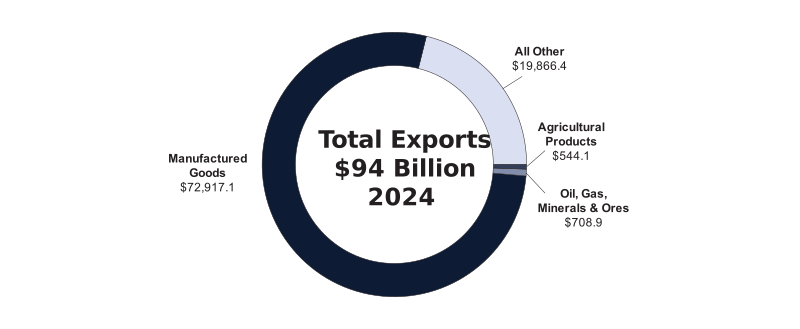
Note: All Other exports include items such as waste and scrap materials, second-hand and used goods, returns of imported items, or low value/de minimis exports.
Source: U.S. Census Bureau, USA Trade Online
Figure 4 – Top 10 Countries for New York Exports, by Commodity Group, 2024
| Agricultural Products | Oil, Gas, Mineral & Ores | Manufactured Products | ||||||
|---|---|---|---|---|---|---|---|---|
| Amount | Share of Total | Amount | Share of Total | Amount | Share of Total | |||
| Canada | $341.1 | 62.7% | Canada | $341.2 | 48.1% | Canada | $9,434.0 | 12.9% |
| China | $94.2 | 17.3% | Netherlands | $76.4 | 10.8% | Switzerland | $8,859.7 | 12.2% |
| United Kingdom | $12.0 | 2.2% | Croatia | $63.6 | 9.0% | Hong Kong | $6,988.4 | 9.6% |
| Vietnam | $8.2 | 1.5% | France | $34.4 | 4.9% | Israel | $5,080.9 | 7.0% |
| Germany | $6.2 | 1.1% | Brazil | $32.1 | 4.5% | United Kingdom | $3,783.9 | 5.2% |
| Estonia | $5.6 | 1.0% | Spain | $29.9 | 4.2% | Mexico | $3,608.5 | 4.9% |
| Mexico | $5.3 | 1.0% | Germany | $29.4 | 4.2% | India | $3,251.0 | 4.5% |
| France | $4.6 | 0.8% | China | $22.0 | 3.1% | Germany | $3,205.2 | 4.4% |
| Hong Kong | $4.6 | 0.8% | United Kingdom | $16.4 | 2.3% | Singapore | $3,106.3 | 4.3% |
| Netherlands | $4.2 | 0.8% | South Korea | $14.6 | 2.1% | China | $2,607.1 | 3.6% |
| World Total | $544.1 | World Total | $708.9 | World Total | $72,917.1 | |||
Note: Dollar amounts in millions
Source: U.S. Census Bureau, USA Trade Online
Looking at specific products, reciprocal trade policies in response to the higher U.S. tariffs likely had a broad negative effect: state exports were lower for nearly two-thirds of product categories reported. Exports of miscellaneous manufactured products, which include such items as sporting goods, jewelry, toys, and office supplies, were $22 billion in 2024 and 23.4 percent of total state exports. In 2025, these exports decreased by $3.4 billion (15.7 percent), the highest among all goods.
Figure 5 – Decrease in New York Exports of Goods, by Type of Product, 2025 (millions of dollars)
| Category | Change from 2024 |
|---|---|
| Miscellaneous Manufactured Products | ($3,447.3) |
| Manufactured Paper and Wood Products | ($189.1) |
| Machinery, Excluding Electrical | ($129.9) |
| Apparel and Accessories | ($124.9) |
| Minerals and Ores | ($109.6) |
| Plastics and Rubber Products | ($100.7) |
| Petroleum and Coal Products | ($71.9) |
| Nonmetallic Mineral Products | ($64.8) |
| Leather and Textiles | ($29.0) |
| Processed Food, Beverages, and Tobacco | ($22.8) |
| Furniture and Fixtures | ($20.7) |
| Fabricated Metal Products | ($20.7) |
| Forestry Products | ($18.8) |
| Printed Matter | ($15.6) |
Note: Nonmetallic mineral products (NAICS code 327) include products such as glass, cement, and clay. Fabricated metal products (NAICS code 332) include metal products that are welded, stamped or forged such as cutlery, tools, bolts and nuts, or shipping containers. Printed matter (NAICS 323) includes such products as newspapers, books, etc. as well as data imaging.
Source: U.S. Census Bureau, USA Trade Online
Similar results were seen with imports to New York; two-thirds of the specific goods also had declines in 2025. The largest was transportation equipment, a decrease of $2.3 billion. This category is largely comprised of motor vehicles and motor vehicle parts, 73.7 percent of transportation equipment imports in 2024. In 2025, these imports were nearly 46 percent lower.
Tariffs and Household Costs
The actual tariff rate paid on goods imported into the U.S. depends on a variety of factors, largely trade agreements with other countries that allow for free or reciprocal trade or exemptions from tariffs for certain products.11 As a result, one measure of the aggregate level of tariffs imposed is the effective tariff rate, as measured by tariff revenue collected as a share of the total value of imports. In April, the effective tariff rate jumped from 2.4 percent to 10 percent, reaching a high of 11.8 percent in November 2025 (see Figure 6). For all of 2025, the average effective tariff rate was 7.7 percent, over five percentage points higher than the 2.4 percent rate in 2024.
Figure 6 – Monthly Effective Tariff Rates, United States, January 2024 to December 2025
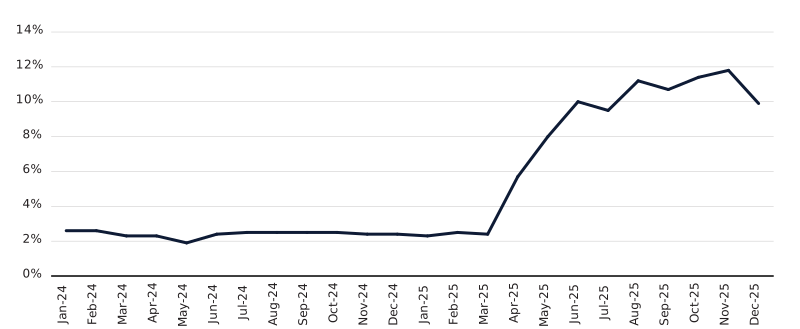
Note: The effective tariff rate is tariff revenue collected as a percentage of the value of total imports.
Sources: U.S. Bureau of Economic Analysis, U.S. International Trade in Goods and Services, U.S. Department of the Treasury, Monthly Treasury Statement
In simple terms, tariffs impact the cost of goods, whether they are imposed on the final good being imported into the U.S. (e.g. automobiles) or on goods used in the production process (e.g. steel for construction or fertilizer for agriculture). Because the tariff is due when the goods enter the country, importers must pay the tariff.12
Whether the tariffs flow through to the prices paid by consumers is dependent upon decisions made by the importing businesses. A business may decide to absorb the tariff, limiting its profits, or to pass the cost through to prices charged to its customers. On the other hand, the business may negotiate with the foreign company for a lower price on the goods it imports; the ultimate cost is the same as it would have been without the tariff. In the latter scenario, the foreign company is incurring the impact of the higher tariff. According to research by the Federal Reserve Bank of New York, the cost of the tariffs overwhelmingly fell on U.S. consumers and businesses in 2025, although the incidence declined from 94 percent in the first half of the year to 86 percent in November.13
Business’ behavior in relation to the pass-through of prices to the consumer, as well as the buildup in inventories prior to the imposition of higher tariffs, clouds the impact on consumer prices. Research from the Federal Reserve Bank of St. Louis that examined inflationary impacts using Personal Consumption Expenditures, the Federal Reserve Board’s preferred metric of benchmarking inflation, found statistically significant increases on prices based on tariffs, in the first few months of 2025.14
Based on the Consumer Price Index, inflation for 2025 was 2.6 percent, slower than the 2.9 percent rate in 2024, but above Federal Reserve benchmark levels.15 After declining by 0.2 percent in 2024, the prices of goods increased 0.9 percent in 2025. Among the individual categories of goods potentially impacted by tariffs, prices for household furnishings, motor vehicle parts and food accelerated from 2024 levels.
Figure 7 – Inflation Rates for Select Goods, 2024 and 2025
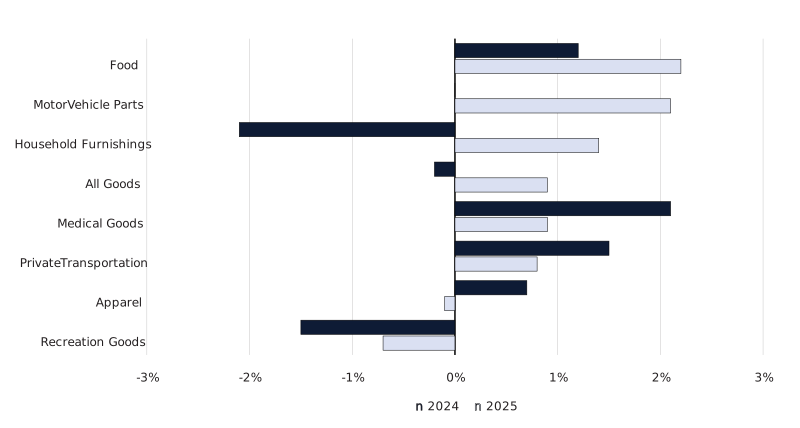
Note: Annual change in Consumer Price Index. Private transportation includes new and used motor vehicles, used cars and trucks, and leases cars and trucks. Food is food consumed at home. Medical commodities include prescription and nonprescription drugs and medical equipment and supplies.
Source: U.S. Bureau of Labor Statistics
Conclusion
Due to a number of factors – including changing tariff levels, pre-buying ahead of the higher tariffs, depreciation of the U.S. dollar, the federal government shutdown, uncertainty regarding business behavior, and substitution of lower tariffed goods or goods from lower tariffed countries – it is difficult to conclusively determine the impact that tariff policy is having on New York’s consumers and businesses. Some research has estimated the average cost to the U.S. household to be in the range of $1,000 per household (Tax Foundation) to $1,751 per household (Yale Lab).16
Tariff policy continues to be a source of economic uncertainty. In 2025, federal revenues from tariffs totaled $264 billion, more than triple the amount collected in 2024.17 In the beginning of the year, the Supreme Court struck down higher tariffs imposed pursuant to the International Emergency Economic Powers Act (IEEPA). This judicial ruling has led to demands by both governmental and business entities for the tariffs applied under IEEPA to be refunded. According to estimates by U.S. Customs and Border Protection, approximately $166 billion in these tariffs were paid by over 330,000 importers.18 Whether and how these refunds will be provided to businesses is unclear.
While the President issued an Executive Order terminating tariffs imposed under IEEPA,19 the Administration has pursued additional tariffs under other laws, including the Trade Act of 1974 (section 122), which are only allowed to remain in place for a temporary period under federal statute. Other tariffs, such as those previously imposed pursuant to section 232 of the Trade Expansion Act of 1962, continue to remain in place and add to economic uncertainty.
In the State Fiscal Year 2027 Executive Budget, the Governor includes a proposal to provide $30 million in direct payments to farmers impacted by tariffs. In addition, she has called on the federal administration to refund tariffs to New York households as a result of the Supreme Court decision. Comptroller Thomas P. DiNapoli has joined other financial officers in advocating for a clear and timely mechanism to reimburse affected taxpayers, businesses, and industries, including restitution for any demonstrable financial losses demonstrated by state governments.
As the levels of tariffs are still in flux and current and potential lawsuits challenge their legality,20 businesses will continue to face difficulties in making long-term investment decisions. As a result, the state of the economy, both nationally and in New York, is likely to continue to experience volatility and uncertainty for the months to come.
Endnotes
1 National Archives, Office of the Federal Register, Presidential Documents, accessed on February 3, 2026.
2 See for example Philippe Andrade et. al., Effects of Tariff Uncertainty on the Outlook of Small and Medium-sized Businesses, Federal Reserve Bank of Boston, September 5, 2025.
3 U.S. Bureau of Economic Analysis, U.S. International Trade in Goods and Services, Part B: NOT Seasonally Adjusted, Exhibit 12. U.S. Trade in Goods. For purposes of this report, the value of both imports and exports are presented on a Census basis which are compiled from documents from U.S. Customs and Border Protection (See explanatory notes, U.S. International Trade in Goods and Services). The value of imports do not include the imposition of tariffs.
4 U.S. Bureau of Economic Analysis, U.S. International Trade in Goods and Services, Part A: Seasonally Adjusted, Exhibit 5. U.S. Trade in Goods
5 Including services, the trade deficit, on a balance of payments basis, was $911.7 billion in 2025, $8.2 billion higher than in 2024. U.S. Bureau of Economic Analysis, U.S. International Trade in Goods and Services, Part A: Seasonally Adjusted (by Commodity/Service), Exhibit 1. U.S. International Trade in Goods and Services
6 U.S. Bureau of Economic Analysis, U.S. International Trade in Goods and Services, Part A: Seasonally Adjusted, Exhibit 11. Real U.S. Trade in Petroleum and Non-Petroleum Products by End-Use, Chained (2017) Dollars
7 U.S. Bureau of Economic Analysis, U.S, International Trade in Goods and Services, Part C: Seasonally Adjusted (by Geography), Exhibit 19, U.S Trade in Goods by Selected Countries and Areas – Census Basis, accessed on March 9, 2026.
8 For purposes of this report, all data in relation to trade by state are primarily taken from the U.S. Census Bureau, USA Trade Online, accessed on February 4, 2026, unless otherwise noted.
9 Includes metal wire, rods, or sheets made from such metals as copper, lead, bronze, and titanium as well as industrial use of gold and silver U.S. Bureau of Labor Statistics, Primary Metal Manufacturing: NAIC 331.
10 From 2024, export and import prices, as measured by the change in the Import/Export Price Indexes, increased significantly, an average annual increase of 35 percent and 36 percent, respectively. U.S. Bureau of Labor Statistics, Import/Export Prices Indexes Databases, NAICS 3314, annual average of monthly year-over-year changes, accessed on March 9, 2026. Excluding these products, exports from Switzerland still increased, but by $419.4 million while imports decreased by just over $1 billion; for the United Kingdom, exports only increased slightly, by $14 million, imports increased by $729 million.
11 U.S. The United States currently has free trade agreements with 20 countries, reciprocal trade agreements with nine countries, as well as trade and investment framework agreements and bilateral investment treaties. Office of the United States Trade Representative, Trade Agreements.
12 Imports to individual persons are, in many cases, “de minimis” shipments; that is, the value of the import is low and depends on the frequency of import. Most countries exempt de minimis shipments from tariffs, the value varying country by country. In the U.S., the de minimis exemption value was $800 (imported by one person on one day). Along with increasing tariffs, other federal actions included targeting this exemption, particularly on de minimis imports from China.
13 Mary Amiti et.al., Federal Reserve Bank of New York, Who Is Paying for the 2025 U.S. Tariffs? - Liberty Street Economics, February 12, 2026.
14 Analysis through August 2025. Maximiliano A Dvorkin et. al., “How Tariffs are Affecting Prices in 2025,” Federal Reserve Bank of St. Louis, October 15, 2025.
15 U.S. Bureau of Labor Statistics, Consumer Price Index, accessed on February 3, 2026. While the Federal Reserve utilizes the change in the personal consumption price index (PCEPI) as its inflation indicator, the results were similar, growth in the PCEPI accelerating after April. For 2025, the annual change of 2.6 percent was the same as in 2024.
16 The Budget Lab at Yale, State of U.S. Tariffs: January 19, 2026 and Erica York and Alex Durante, “Tariff Tracker: Impact of Trump Tariffs & Trade War by the Numbers,” Tax Foundation, March 13, 2026.
17 U.S. Department of the Treasury, Bureau of the Fiscal Service, Monthly Treasury Statement of Receipts and Outlays of the United States Government, Table 3. Summary of Receipts and Outlays of the U.S. Government, accessed on January 15, 2026.
18 Atmus Filtration, Inc. v. United States, U.S. Customs and Border Protection; and Rodney S. Scott, United States Court of International Trade Case 1:26-cv-01259-RKE, Document 31, filed March 6, 2026. Office of the New York State Attorney General, press release, Attorney General James Calls on Congress to Pass Legislation Requiring Tariff Refunds, March 18, 2026.
19 Federal Register: Ending Certain Tariff Actions, Executive Order 14389, February 20, 2026.
20 Office of the New York State Attorney General, press release; Attorney General James Leads Lawsuit to Stop Trump Administration’s Latest Illegal Tariffs, March 5, 2026.